
Recruitment Language in Transition
Part 1: A longitudinal comparison of recruitment rhetoric, behavioural signalling and workplace identity language across the UK labour market.
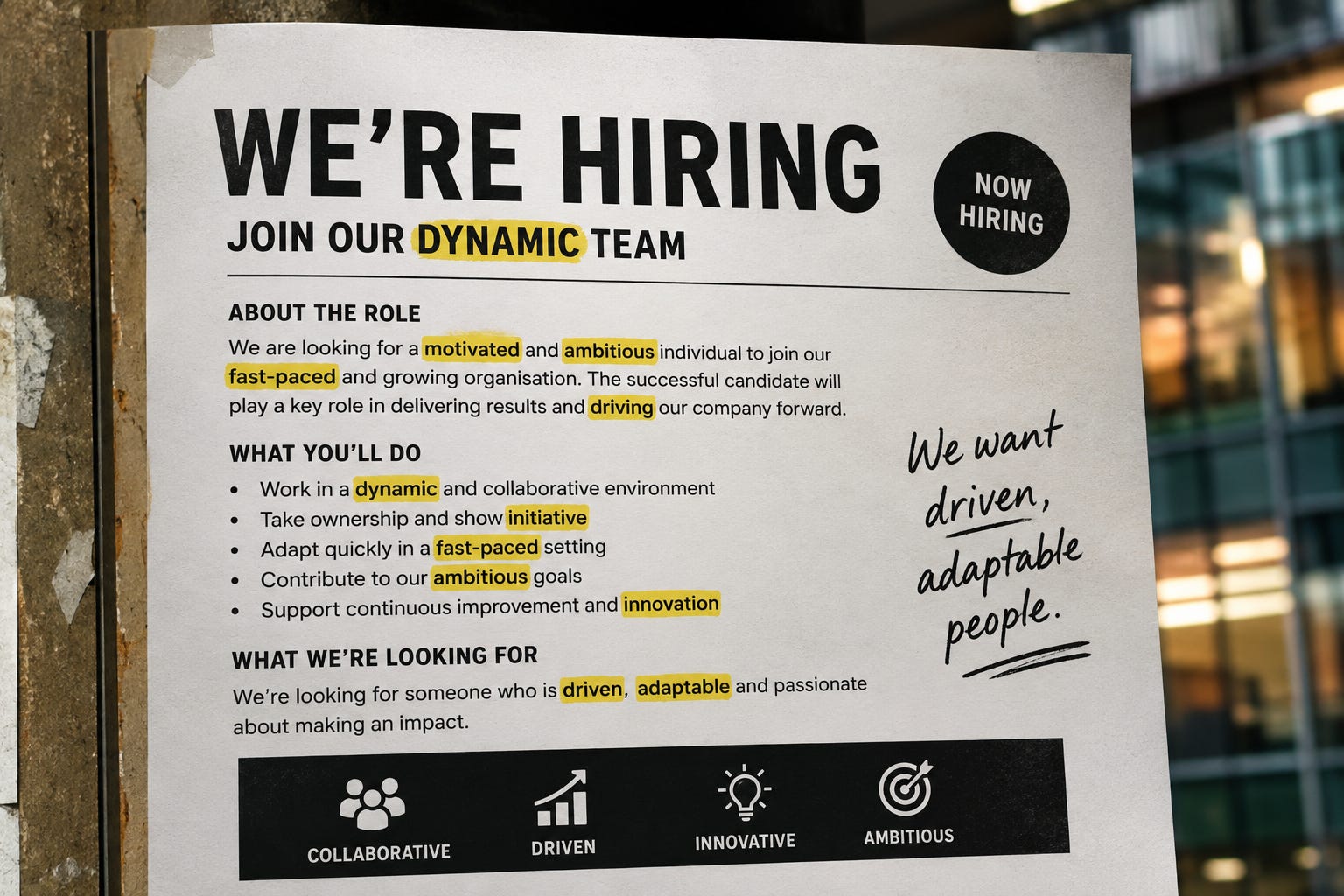
Series: Recruitment Language in Transition
The Question Behind the Analysis
For the past 7 months, I’ve been analysing UK job advert language as part of a wider research project exploring behavioural signalling and workplace culture in recruitment.
The original October 2025 dataset formed part of the earlier Agents at Work research series (Phases 1 & 2), which examined age-adjacent language and recurring behavioural cues across UK job adverts.
My earlier behavioural evaluation research explored how AI-supported systems behave under repetition and constraint. I became interested in whether similar forms of repetition and recurring behavioural patterns were beginning to appear within organisational language itself as AI-assisted writing tools became more widely used.
My interest was not limited to recruitment itself. Job adverts provided a useful starting point because they are one of the few large-scale forms of organisational communication that are publicly available, regularly updated and accessible for systematic analysis. While organisations generate many other forms of text – including internal communications, customer correspondence, policy documents and marketing materials – these are often difficult to obtain at scale. Recruitment adverts therefore offered a visible and measurable window into how organisations describe themselves, the behaviours they value and the workplace identities they seek to construct.
I collected a second dataset of 5,500 advert texts across the same roles in May 2026 to explore whether recruitment rhetoric had changed over time and whether those changes revealed anything about wider workplace culture.
As the comparison developed, something more interesting began to emerge. The analysis suggested that the adverts were doing more than simply repeating isolated phrases. They were constructing recurring workplace identities and behavioural expectations across the labour market.
When I compared the October 2025 and May 2026 datasets, one pattern stood out almost immediately.
The language did not become less intense.
It became more aspirational in tone and more culturally embedded.
From Pressure to Aspiration
October 2025 dataset
The dominant rhetoric felt overtly performance-oriented. Phrases such as:
“fast-paced”
“results-driven”
“dynamic”
appeared frequently and often clustered together. The strongest co-occurrence patterns created a fairly recognisable workplace identity — high-energy, acceleration-focused and visibly pressure-oriented.
Many of the adverts framed employability through speed, urgency and output. Even when the roles themselves varied, the cultural tone often sounded remarkably similar.
What became noticeable across the dataset was not simply the repetition of individual words, but the tendency for particular phrases to repeatedly appear together. Terms such as:
“dynamic”,
“fast-paced”,
“driven” and
“results-driven”
frequently clustered within the same adverts, reinforcing a shared rhetorical style centred around acceleration, energy and performance intensity.
May 2026
The overall behavioural emphasis had not disappeared, but the presentation had changed. The later dataset showed stronger growth in phrases such as:
motivated
ambitious
graduate
trainee
Meanwhile, some overtly energetic language, particularly “dynamic”, weakened substantially.
Different clusters now became more prominent, especially combinations involving “motivated”, “ambitious”, “graduate” and “trainee”, creating a softer but still highly directional aspirational tone.
The strongest phrase pairing in the May dataset became:
“graduate + trainee”
It is maybe not that surprising that those two words co-occur, but the change matters because it alters the emotional tone of the adverts, even when many underlying behavioural expectations remain similar.
The comparison draws on a wider behavioural-signalling framework developed during the earlier Agents at Work research series, combining structured cue detection with interpretive analysis of recurring rhetorical patterns across the adverts.
The project does not examine isolated keywords in abstraction, but explores how repeated phrase combinations, co-occurrence patterns and recurring behavioural signals contribute to broader workplace narratives and organisational identity formation.
In summary
The October language often sounded more explicitly demanding.
By May 2026, aspirational and development-oriented language had become substantially more prominent alongside many of the same high-energy expectations.
The Pressure Didn’t Disappear
The pressure did not vanish but became more culturally polished.
That distinction feels important because recruitment language rarely operates as a neutral description of tasks.
At scale, it begins to function more like a behavioural signalling system. Repeated combinations of phrases create implicit expectations around pace, ambition, adaptability and workplace identity.
Recruitment Language Shift
October 2025 vs May 2026
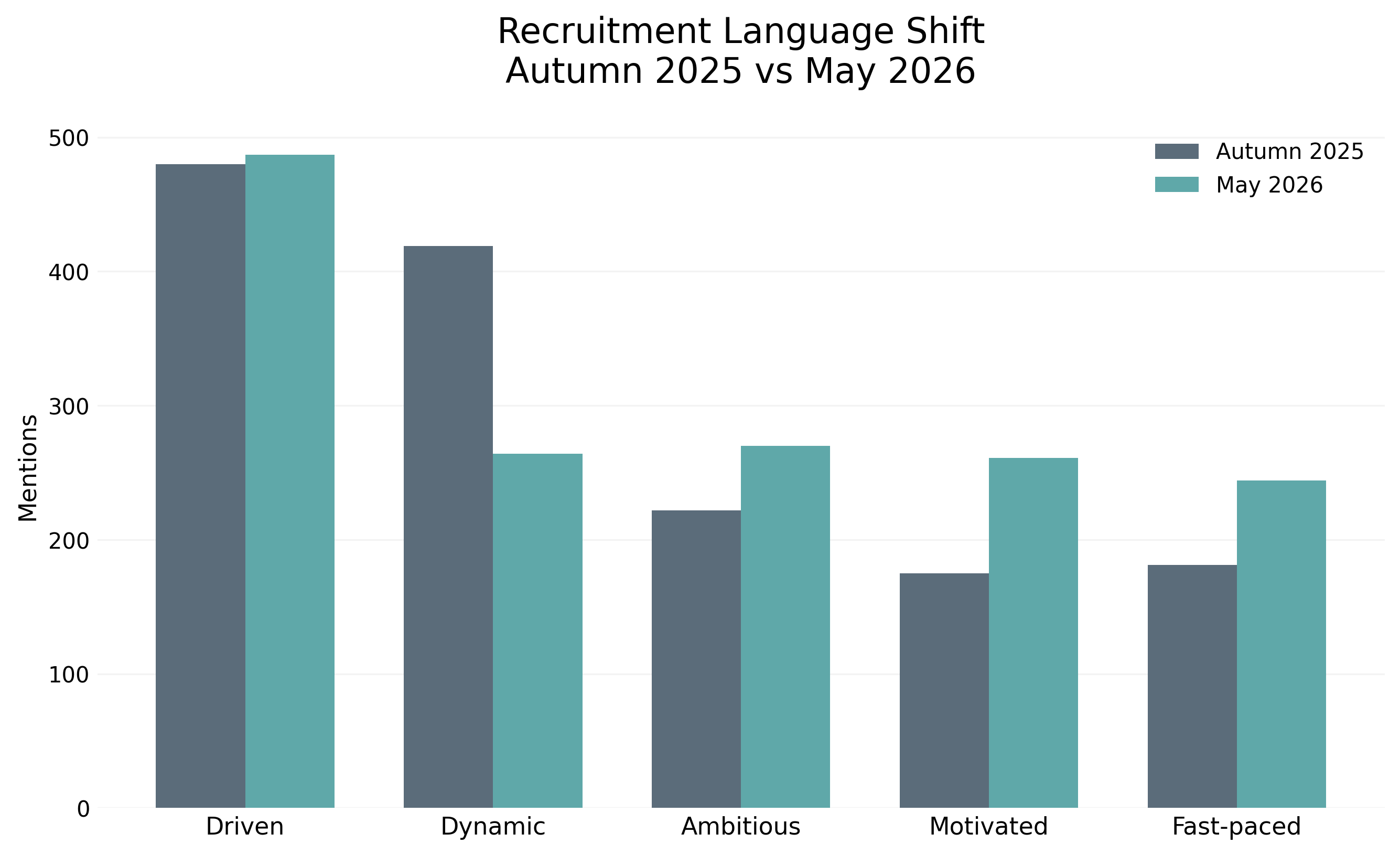
The comparison suggests that recruitment rhetoric evolved unevenly rather than moving in a single direction. Some overtly energetic signals weakened, while motivational and aspirational language became substantially more prominent.
One particularly notable movement was the sharp decline in the use of “dynamic”, which fell substantially between the two collection periods. This may reflect a broader rhetorical movement away from visibly high-intensity corporate language toward softer aspirational and identity-based signalling. Unlike terms such as “motivated” or “ambitious”, “dynamic” increasingly feels associated with an older style of overt performance rhetoric rather than contemporary development-oriented recruitment language.
Shared Signals Across Occupations
One of the most interesting findings from the comparison was how widely distributed many of these signals had become. Terms such as “driven”, “ambitious” and “motivated” appeared across multiple role categories rather than remaining confined to particular occupations or levels of seniority, which raises an interesting possibility.
Some behavioural signals may function less as occupation-specific requirements and more as broadly shared indicators of employability. Rather than describing the technical demands of a role, they communicate expectations about attitude, motivation, adaptability and workplace behaviour.
What became noticeable across the dataset was not simply the repetition of individual words, but the extent to which the same age-adjacent behavioural signals appeared across very different forms of work.
This does not mean that occupations are linguistically identical. Different roles continue to contain distinct technical requirements, responsibilities and occupational language. However, it does suggest that certain behavioural expectations are communicated through a relatively small group of widely distributed signals.
AI Transformation vs Recruitment Reality
One slightly unexpected finding involved the relative absence of explicit AI-related language across much of the dataset.
Despite the wider public discussion surrounding AI transformation, many adverts outside technical and analytical roles continued to rely far more heavily on traditional behavioural and cultural-fit rhetoric than explicit references to AI capability or adaptability.
Terms associated with motivation, flexibility, ambition and workplace attitude remained considerably more visible than AI-specific language across many operational and professional roles.
That contrast may become increasingly interesting as organisations continue integrating AI tools into everyday working practices.
What Changes Slowly
What emerged most strongly from the comparison was not evidence of dramatic linguistic revolution, but gradual cultural normalisation.
The October 2025 dataset contained more overt behavioural and aspirational intensity.
By May 2026, similar expectations appeared more embedded within development-oriented and aspirational workplace rhetoric.
Some of these rhetorical movements may also reflect differences in the composition of advertised roles between the two collection periods.
To explore this possibility further, I compared the salary distributions across both collection periods.
Salary Distribution Comparison
After cleaning missing, malformed and extreme salary values, the overall salary distributions across the October 2025 and May 2026 datasets remained remarkably similar.
Mean midpoint salary:
October 2025: ~£48.6k
May 2026: ~£49.6k
Median midpoint salary:
October 2025: ~£45.0k
May 2026: ~£45.5k
This is important because it suggests the rhetorical differences cannot be explained solely by a substantial movement toward significantly more junior or lower-paid roles within the later dataset.
While some compositional differences likely remain, the findings suggest that at least part of the change may reflect genuine movement in recruitment rhetoric rather than salary structure alone.
That movement may seem subtle, but subtle shifts are often how labour-market culture changes. Recruitment language evolves gradually through repetition, saturation and normalisation rather than sudden replacement.
The findings do not establish discriminatory intent or recruitment outcomes directly. They do, however, suggest that recruitment language functions as a recurring cultural system and one that shapes how organisations present work, how applicants interpret employability and how workplace expectations become socially embedded over time.
This comparison is only an initial snapshot across two collection periods, but it shows that longitudinal recruitment-language analysis may reveal much more than isolated phrase audits ever could.
What changes over time is often not simply vocabulary. It is the way organisations learn to present expectations as culture.
A Question of Distinctiveness
Several of the most common behavioural signals appeared across multiple role categories and occupational groups rather than remaining confined to particular sectors or levels of seniority.
The findings in this article suggest that some behavioural signals are widely shared across occupations. However, the presence of shared signals does not necessarily mean that occupations themselves are becoming linguistically alike.
Different forms of work may continue to retain distinct occupational identities while drawing upon a common set of behavioural expectations.
The next article explores that distinction by examining how behavioural signals are distributed across occupations and asking a related question: which signals appear widely across the labour market and which remain more strongly associated with particular forms of work?
In Brief
The most significant change was not a dramatic change in vocabulary, but a gradual movement in how workplace expectations were framed.
Because recruitment language helps communicate organisational values and expectations, small changes in rhetoric may reveal broader changes in workplace culture over time.
What’s Next
This comparison only begins to scratch the surface of how behavioural expectations are communicated through recruitment language.
Future analysis will explore:
recurring behavioural patterns across roles
occupational distinctiveness and shared behavioural signals
organisational distinctiveness
aspirational rhetoric over time
recurring workplace expectation language across the labour market
The more adverts I analyse, the more the language itself appears to reveal broader patterns about work, identity and organisational culture in the age of AI-assisted communication.
This article forms part of an ongoing longitudinal research project exploring behavioural signalling, organisational language and AI-assisted recruitment communication across the UK labour market.
Extended findings editions and research summaries will be developed as the project expands.
Methodological Note
This analysis focuses on a defined set of age-adjacent behavioural and workplace signals identified through a custom research dictionary developed for the project. The findings therefore relate to patterns within this signal set rather than all language used in job adverts.
The analysis is designed to explore how organisations communicate behavioural expectations, career stage assumptions, experience signals and related workplace characteristics. It should not be interpreted as a comprehensive analysis of all recruitment language or all forms of organisational communication.
Further Reading
This analysis forms part of a broader research programme exploring how AI-assisted systems influence organisational communication, workplace expectations and decision-making.
If these findings resonate with observations or questions within your own organisation, I’d be interested in hearing from you.
Further reports, guides and research publications are available via Beyond the Average.